Table of Contents
- Understanding HMO Compliance Requirements
- HMO Planning Permission vs Licensing 2026
- HMO Fire Safety Regulations Checklist
- HMO Room Size Standards and Occupancy Rules
- Gas, Electrical, and Safety Inspections
- HMO Management Software for Landlords
- Common Compliance Mistakes and How to Avoid Them
- Frequently Asked Questions
Last Updated: 3 September 2026
Understanding HMO Compliance Requirements
HMO compliance is mandatory. Operating within the regulatory framework covering licensing, fire safety, room standards, and management responsibilities is non-negotiable. Miss these requirements and you face fines, prosecution, or forced closure.
These requirements form an integrated system: fire safety equipment, room size standards, gas and electrical inspections, and licensing all interconnect. Fail one element and the entire structure becomes non-compliant.
Not every multi-occupancy house requires an HMO licence. The threshold depends on occupant numbers, household composition, and local authority designation. Verify requirements before letting to avoid operating illegally.
HMO Planning Permission vs Licensing 2026
Planning permission and HMO licensing operate through different systems. Planning permission concerns use classification (converting to HMO use). HMO licensing is a separate management and safety requirement.
Planning permission for HMO conversion became mandatory in 2021 under Class C4. Properties with three to six unrelated occupants need permission to change from Class C3 to C4 (gov.uk). Properties with seven or more occupants fall under statutory HMO definition with varying local thresholds.
HMO licensing operates independently of planning status. Even with valid planning permission, you still require an HMO licence if the property meets the statutory definition. Most councils now require licensing for properties with three or more occupants from separate households.
Secure planning permission first, then apply for HMO licensing. Operating without both exposes you to enforcement action triggered by complaints or routine audits.
HMO Fire Safety Regulations Checklist
Fire safety is the most heavily regulated aspect of HMO management. Regulations are statutory, enforced through regular inspections and surprise visits. Your property must meet standards before letting and maintain compliance throughout tenancy.
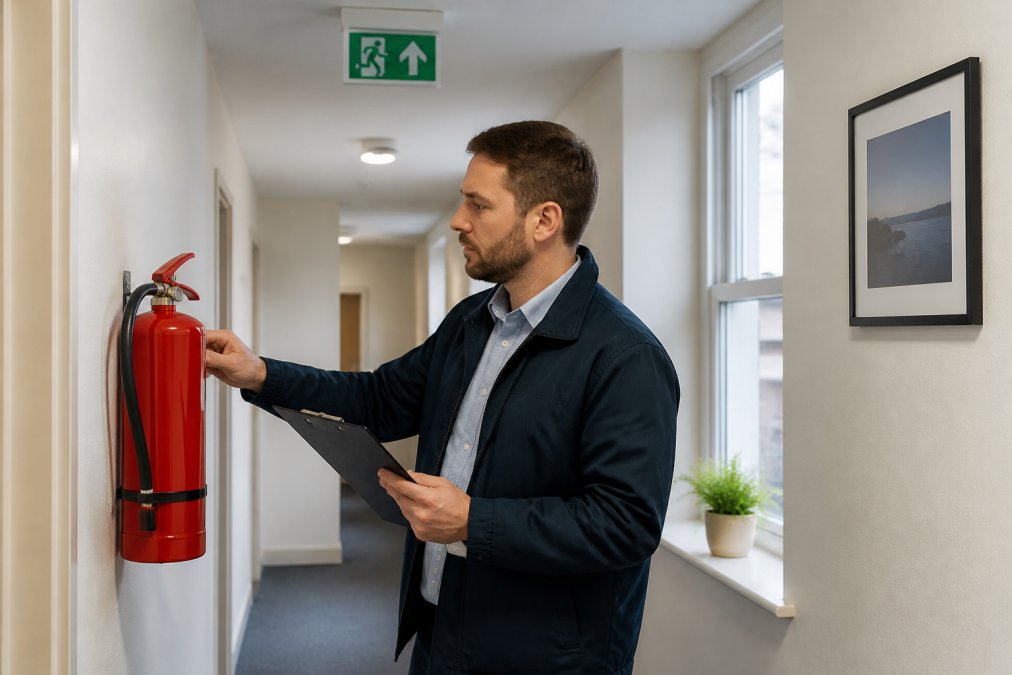
Core fire safety requirements include emergency lighting, fire detection systems, fire extinguishers, emergency exit routes, and signage. Emergency lighting guides occupants in smoke. Smoke alarms provide early warning. Extinguishers allow occupants to tackle small fires. Exit routes must be unobstructed and clearly marked.
Your fire safety checklist should include:
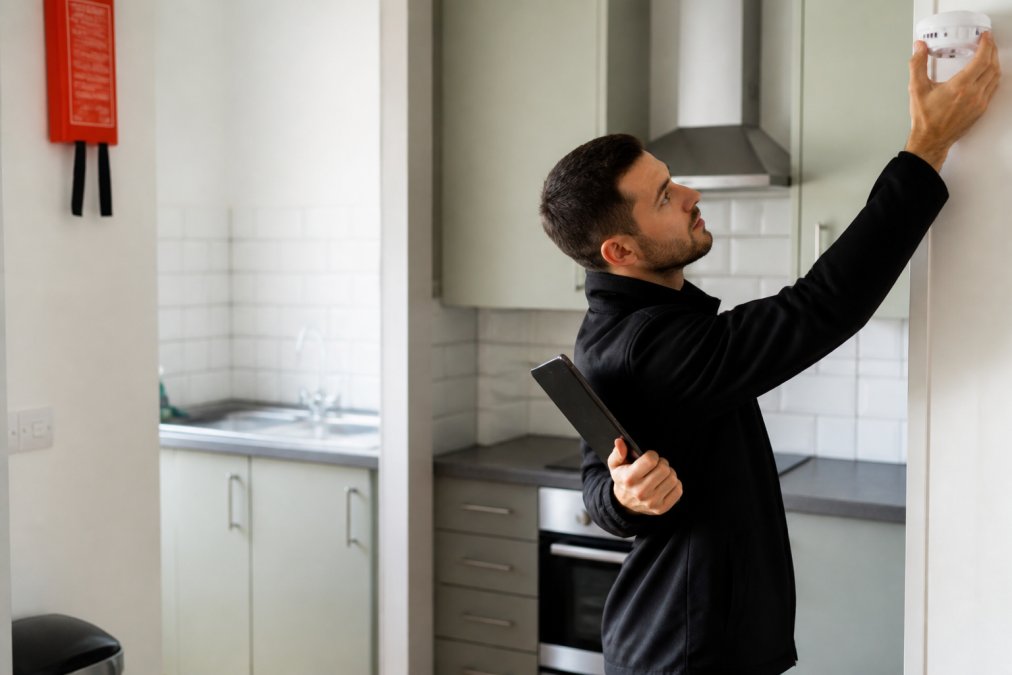
- Smoke alarms on every level of the property, positioned outside bedrooms and in communal areas
- Heat alarms in kitchens (smoke alarms trigger false alarms near cooking)
- Emergency lighting in hallways, stairs, and communal areas
- Fire extinguishers positioned near potential fire sources (kitchen, boiler room)
- Fire blankets in the kitchen
- Emergency exit routes clearly marked with illuminated signage
- Unobstructed escape routes with no locked doors blocking exit
- Fire safety information provided to occupants in writing
- Records of all fire safety inspections and maintenance
Standard domestic smoke alarms don't satisfy HMO requirements. Regulations require interlinked alarms (wired or wireless) that trigger simultaneously throughout the property.
Testing and maintenance are ongoing obligations. Smoke alarms require monthly testing and annual professional servicing. Fire extinguishers require annual inspection. Emergency lighting requires quarterly testing. All must be documented.
HMO Room Size Standards and Occupancy Rules
Room size standards prevent overcrowding, fire hazards, and disputes. Regulations specify minimum floor areas that determine legal occupancy limits.
Bedrooms must measure at least 70 sq ft for one occupant and 110 sq ft for two (gov.uk). Measurements exclude fitted wardrobes and built-in storage. A room measuring 69 sq ft fails the standard.
Communal areas require minimum floor space proportional to occupants (typically 50 sq ft per person). Kitchens require adequate work surface, storage, and appliances for the number of occupants.
Occupancy limits flow directly from room sizes. Attempting to maximise income by overcrowding results in licence refusal or enforcement action.
Inspectors use laser measures from internal walls, accounting for built-in furniture. Sloped ceilings, fitted wardrobes, radiators, and shelving reduce usable space. Rooms often measure smaller than expected.
Measure each room using a laser measure before letting. Document dimensions and photograph them to have evidence of compliance before the licensing inspection.
Gas, Electrical, and Safety Inspections
Gas and electrical safety inspections are non-negotiable legal requirements. Faulty installations expose you to criminal liability if an accident occurs.
Gas safety requires annual certification from a Gas Safe registered engineer (gassaferegister.co.uk). The certificate must be provided to tenants before move-in and kept on file. Failing to provide tenants with a copy breaches the Gas Safety (Installation and Use) Regulations 1998.
Electrical safety requires inspection from a NICEIC-certified electrician producing an Electrical Installation Condition Report (EICR). New installations require detailed inspection; existing installations require EICR every five years.
Gas safety is annual; electrical safety operates on a five-year cycle. Both require documented evidence on file and must be shared with tenants. You cannot let a property with failed certificates or outstanding defects.
Schedule inspections proactively at the start of the financial year, not when licence renewal deadlines approach. This allows time to address defects before the next cycle and avoids inflated contractor costs.
Keep all inspection certificates on file for at least five years. Local authorities request these during compliance audits. If you cannot produce a current gas safety certificate or electrical inspection report, the authority will assume the installations are unsafe and may issue an improvement notice requiring immediate inspection and certification.
HMO Management Software for Landlords
Managing HMO compliance manually across multiple properties risks missing critical deadlines. Compliance software automates tracking, sends reminders, and centralises documentation.
Core features include compliance calendars, document storage, tenant management, maintenance tracking, and inspection scheduling. Some platforms integrate with local authority systems for direct application submission.
Software reduces administrative burden and human error risk but doesn't eliminate your compliance responsibility. It ensures you don't miss deadlines.
For single properties, a spreadsheet may suffice. For multiple properties across different authorities, software is essential. The cost of missing a deadline far exceeds subscription costs.
Many platforms provide regulatory updates as requirements change, valuable since HMO regulations evolve.
Common Compliance Mistakes and How to Avoid Them
The most frequent HMO compliance failures follow predictable patterns. Understanding these mistakes allows you to avoid them systematically rather than discovering them during an inspection.
Mistake 1: Assuming you don't need a licence. Most councils now operate mandatory licensing for HMOs with three or more occupants. Check your local authority's website or contact the licensing team to confirm requirements.
Mistake 2: Letting the property before the licence is granted. Wait for the licence to be issued before accepting tenants. Letting before approval risks operating illegally if the application is refused or requires remedial work.
Mistake 3: Failing to renew the licence before expiry. Submit renewal applications three months before expiry to allow time for inspections or remedial work.
Mistake 4: Not providing copies of gas safety and electrical certificates to tenants. Provide copies when tenants move in and keep evidence of this provision on file.
Mistake 5: Overcrowding based on assumptions about room size. Always measure rooms using a laser measure and verify dimensions against local authority standards before determining occupancy.
Mistake 6: Treating fire safety equipment as a one-time installation. Create a maintenance schedule for regular testing and document all activities on file.
Mistake 7: Not maintaining records of compliance activities. Keep all documentation (certificates, maintenance records, correspondence, proof of tenant communications) for at least five years.
Managing HMO compliance successfully requires understanding the interconnected regulations, maintaining detailed records, and staying ahead of renewal deadlines. For landlords managing multiple properties or lacking the time to track these complex requirements independently, outsourcing compliance management to a professional service eliminates operational risk and frees you to focus on your core business.
Lord Panda Property handles HMO licensing, fire safety, gas and electrical inspections, and ongoing compliance management across the South and South West. Book a consultation to discuss how professional compliance management can protect your investment.
Frequently Asked Questions
What are the mandatory fire safety requirements for HMOs?
All HMOs must have working smoke alarms on every level, fire extinguishers in accessible locations, and clearly marked emergency exits. Properties must comply with the Fire Safety Order 2005. Annual electrical and gas safety checks are mandatory, and a fire risk assessment must be completed and documented. Fire doors must be fitted and kept closed, and tenants must receive fire safety information in writing.
How do I know if my property requires an HMO licence?
Your property needs an HMO licence if it has three or more storeys, houses five or more people from two or more households, and shares facilities like bathrooms or kitchens. Some local authorities have additional licensing schemes for smaller HMOs. Check your local council's website to confirm requirements for your area, as rules vary by location.
What are the penalties for non-compliance with HMO compliance regulations?
Operating an unlicensed HMO can result in fines up to £20,000 per breach, prosecution, and potential seizure of rental income. Failing fire safety checks, electrical inspections, or gas safety certificates attracts separate penalties. Local authorities can issue enforcement notices requiring immediate corrective action, and repeated breaches may lead to criminal charges against you as the landlord.
How often must HMO gas and electrical safety checks be carried out?
Gas safety certificates must be obtained annually by a Gas Safe registered engineer and provided to tenants within 28 days of the inspection. Electrical installations must be tested every five years by a qualified electrician, with portable appliances checked annually. These records must be kept for at least three years and made available to local authorities on request.
This article was written using GrandRanker