
Last Updated: 16 November 2026
Quick Summary
HMO landlord insurance requirements are set mainly by your insurer and lender, not a single statute, and differ across England, Wales, Scotland and Northern Ireland. A house in multiple occupation is one let to three or more tenants forming more than one household and sharing facilities, which carries a different risk profile from a single let.
- Confirm your tenant and household count, since three or more tenants forming more than one household defines an HMO.
- Gas safety, electrical safety and fire safety are legal duties that apply whether or not you hold insurance.
- Insurer conditions, such as accurate occupancy declarations and maintenance records, are separate and can affect a claim.
- Keep a written fire risk assessment, alarm test log and installation certificates to prove compliance if a claim arises.
- Review your policy each year and whenever occupancy, licensing or the property's condition changes.
Table of Contents
- What Makes a Property an HMO and Why It Changes Your Insurance
- Is HMO Landlord Insurance a Legal Requirement?
- HMO Insurance Requirements in 2026: Legal Duties Versus Insurer Conditions
- HMO Fire Safety Requirements Your Insurer Will Check
- What Standard HMO Insurance Covers and Its Common Exclusions
- Step-by-Step HMO Insurance Application Checklist
- Booking Your Compliance Review With Lord Panda Property
- Frequently Asked Questions
What Makes a Property an HMO and Why It Changes Your Insurance
A house in multiple occupation (HMO) is a property rented to three or more tenants who form more than one household and share facilities such as a kitchen or bathroom (Private renting: Houses in multiple occupation).
HMO landlords across the South and South West of England often find that the declared use of a property does not match how it is actually let. Checking your HMO landlord insurance requirements early avoids that gap. Check the number of tenants, the number of households and the shared facilities before you assume any cover applies.
Is HMO Landlord Insurance a Legal Requirement?
In most cases, there is no single UK statute that makes landlord insurance compulsory for an HMO. What the law does require is a set of landlord duties, including gas safety, electrical safety and fire safety, along with licensing in many areas. Insurance is usually a contractual matter between you and your lender or insurer, not a standalone legal obligation.
Mortgage lenders commonly require buildings cover, and many will not lend against an HMO without specialist arrangements. That makes insurance a practical necessity even where the law does not name it. Confirm the position with your lender and your local council, since licensing rules differ by area.
HMO Insurance Requirements in 2026: Legal Duties Versus Insurer Conditions
It helps to separate two lists. Legal duties come from legislation and apply whether or not you have insurance. Insurer conditions are terms in your policy, and breaching them can reduce or void your cover even when the underlying duty is met.
Examples of legal duties include gas safety certification, electrical safety checks and fire safety measures. Examples of insurer conditions include notifying the insurer of a change in the number of occupants, keeping records of maintenance and meeting any specific protection standards written into the policy. Review both lists against your current policy each year.
England, Wales, Scotland and Northern Ireland Compared
HMO rules are not identical across the UK, and applying England-specific licensing rules to a property in another nation is a common and costly error. The table below sets out the framework to check for 2026; confirm current thresholds and local schemes with the relevant council or national regulator before you rely on any of it.
| Nation | Mandatory licensing trigger to check | Additional or selective schemes | Regulator or route for confirmation |
|---|---|---|---|
| England | The mandatory HMO licence applies to larger HMOs, generally those with five or more occupants forming two or more households and sharing amenities; confirm the current threshold with the local authority | Additional and selective licensing schemes vary by council area and change over time | Local authority housing team |
| Wales | HMO licensing is administered under the national rental framework, with a mandatory route for HMOs above the prescribed threshold and a separate route for smaller HMOs; confirm the current position | Local authorities may operate additional schemes | Local authority housing team |
| Scotland | HMO licensing is a national system administered through the local authority, with a licence required for properties meeting the HMO definition; confirm current room and amenity standards | The national system applies rather than council-by-council additional schemes | Local authority licensing team |
| Northern Ireland | HMO licensing is administered under the regional housing framework, with a mandatory licence for properties meeting the HMO definition; confirm current standards | The regional framework applies rather than council-by-council additional schemes | Northern Ireland Housing Executive |
Three practical points follow from that table. First, the definition of an HMO itself can differ, so a property that needs a licence in one nation may not meet the threshold in another. Second, room size and amenity standards are set nationally or locally and are checked at licensing inspection, so measure rooms before you apply rather than after. Third, licensing status is a fact you must declare to your insurer; a policy written on the basis of an unlicensed HMO can be challenged at claim stage.
Watch out: a licence granted for a lower occupancy does not authorise you to add a tenant, and an insurer told about three occupants may treat a fourth as a material change you failed to disclose.
The 2026 compliance checklist: legal duty or insurer condition?
Use the checklist below to separate what the law demands from what your policy demands. The responsible party and evidence columns are the part most landlords skip, and they are the part an insurer or council will ask for first.
| Item | Legal duty or insurer condition | Responsible party | Evidence to keep |
|---|---|---|---|
| Gas safety check by a registered engineer | Legal duty | Landlord | Current gas safety record, renewed annually |
| Electrical installation condition report | Legal duty | Landlord | Report showing the inspection date and any remedial work |
| Fire risk assessment | Legal duty | Landlord or responsible person | Written assessment with actions and review date |
| Smoke and heat alarms, fire doors and escape routes | Legal duty, and often an insurer condition | Landlord | Photographs, installation records and maintenance log |
| HMO licence | Legal duty where the scheme applies | Landlord | Licence certificate and any conditions attached |
| Accurate declaration of occupancy and use | Insurer condition | Landlord or broker | Copy of the proposal and any mid-term notifications |
| Maintenance records | Insurer condition | Landlord | Dated invoices and contractor reports |
| Notification of vacancy or refurbishment | Insurer condition | Landlord | Written notice to the insurer and their response |
Review both lists against your current policy each year, and again whenever the occupancy, licensing position or condition of the property changes. The distinction matters because a breach of an insurer condition can affect a claim even where every legal duty has been met, and meeting every insurer condition does not discharge a legal duty.
HMO Fire Safety Requirements Your Insurer Will Check
Fire safety is one of the first areas an insurer will examine, and it is also one of the few where the legal duty and the insurer condition overlap almost completely. Expect questions about detection, compartmentation, escape and documentation, and expect to prove each one rather than describe it.
What insurers and councils actually look for
- Detection. Smoke alarms in circulation areas and heat detection in kitchens are the baseline most assessors work from, with the exact specification depending on the property's layout and the assessment. Interlinked detection is a common expectation in larger HMOs.
- Compartmentation. Fire doors to bedrooms and shared areas, self-closing mechanisms and intumescent strips are the features most often checked, because they buy escape time in a shared building.
- Escape routes. Protected routes, clear corridors and, where the assessment requires it, emergency lighting. A route blocked by stored furniture is a finding, not a detail.
- Signage and notices. Fire action notices in shared areas and, in larger properties, a log of checks and drills.
- The fire risk assessment itself. A written assessment that identifies hazards, records who is at risk, sets out actions and carries a review date. An assessment with no actions and no review date reads as a tick-box exercise.
The evidence trail to keep
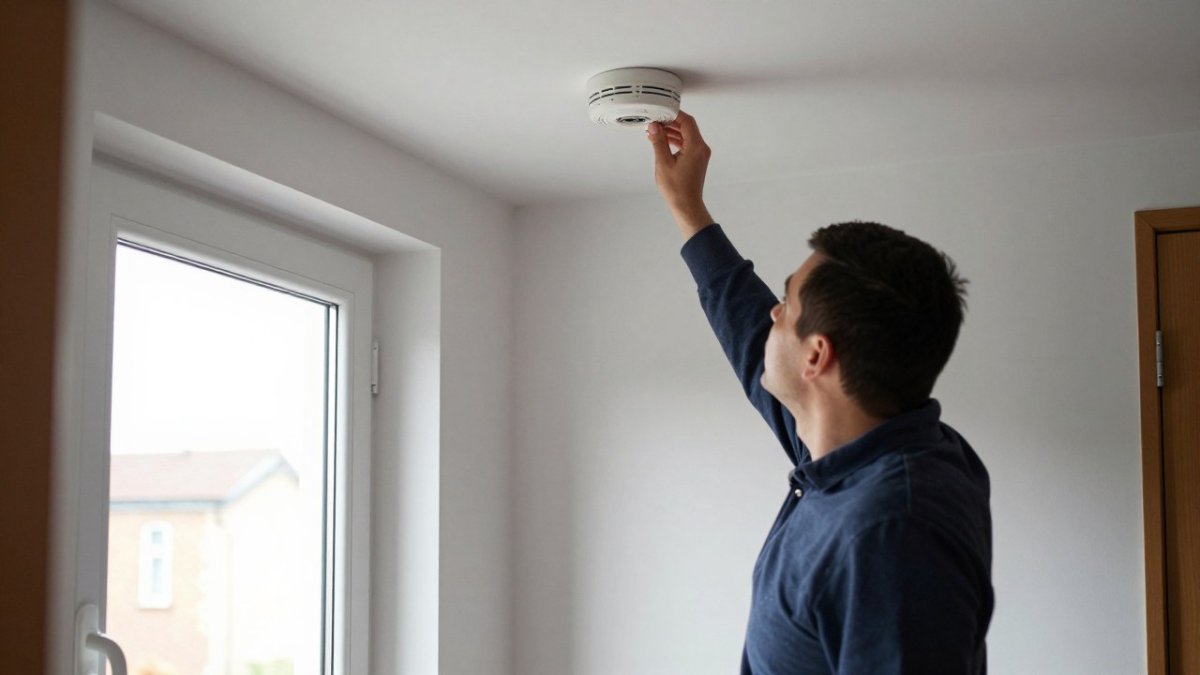
Compliance is not just a tick-box exercise. A fire risk assessment identifies hazards, and an insurer may ask to see it. Store it with your gas and electrical certificates so you can produce them quickly, and keep the supporting evidence alongside it: installation certificates for alarms and doors, photographs of the finished work, maintenance invoices and a dated log of alarm tests. If a claim arises, the question is rarely whether you intended to comply but whether you can show that you did.
Watch out: a fire risk assessment completed before a refurbishment, or before a change in occupancy, may no longer reflect the property, and an insurer can treat a stale assessment as evidence that the condition was not maintained.
Where the legal duty and the insurer condition diverge
The legal framework sets the minimum, and your policy can ask for more. An insurer may, for example, require a particular specification of door or a documented maintenance regime that goes beyond what an inspection would demand. Read the fire safety conditions in your policy as a separate list and check each one against the property, rather than assuming that passing a council inspection satisfies the insurer. Where the two diverge, meet the higher standard and keep the evidence for both.
What Standard HMO Insurance Covers and Its Common Exclusions
A typical HMO policy combines several elements. Buildings cover protects the structure against insured perils such as fire, storm and escape of water. Landlord contents cover applies to furniture and appliances you provide.
Common exclusions include damage caused by poor maintenance, deliberate acts by tenants beyond the policy wording, and losses that arise from breaching a policy condition. Read the exclusions section carefully and ask the insurer to explain any term you do not understand. Confirm whether tenant-related losses such as malicious damage are covered and whether any excess applies.
Step-by-Step HMO Insurance Application Checklist
- Confirm the exact number of tenants and households, and the shared facilities.
- Check your licensing status with the local council.
- Obtain current gas and electrical safety certificates.
- Complete a fire risk assessment and record any actions taken.
- Declare the HMO use accurately to the insurer or your broker.
- Compare buildings, contents and public liability cover, including limits and excesses.
- Read the policy conditions and note any notification duties.
- Set a reminder to review cover at renewal or whenever occupancy changes.
Accurate disclosure at the application stage is the most important step. A policy written on the wrong basis can be challenged at claim time.
Booking Your Compliance Review With Lord Panda Property
We take a disciplined approach to every HMO we manage across the South and South West of England. We take responsibility for tenant management, maintenance and compliance on a long-term contract.
For a clear view of where your HMO stands against current requirements, book a consultation with our team through our website. Pricing depends on the property and the arrangement, so contact us for a quote.
Frequently Asked Questions
Is HMO landlord insurance a legal requirement?
In the UK, there is generally no statute that obliges a landlord to hold HMO landlord insurance. However, mortgage lenders often require buildings cover, and standard policies frequently exclude or limit cover for HMOs. Without a policy written for HMO use, a claim can be refused or reduced. Check your mortgage conditions and your policy wording, and confirm the HMO use has been disclosed to your insurer.
Does standard landlord insurance cover an HMO?
Not always. Many standard landlord policies are written for single-let properties and may exclude or restrict cover once a property is let to several unrelated occupants. Declare the HMO use accurately at application and ask the insurer to confirm in writing that your policy covers multiple occupation. An undisclosed change of use is one of the most common grounds for a disputed claim.
What information do insurers need to insure an HMO?
Insurers typically ask for the number of bedrooms and occupants, the number of households, whether the property is licensed, the fire safety measures in place, the age and construction of the building, and the rebuild cost. They may also ask about tenant referencing and how the property is managed. Accurate answers at application protect you if you later need to make a claim.
Can an insurer refuse a claim if an HMO does not meet safety requirements?
Yes, it is possible. If a policy condition requires working smoke alarms, fire doors or a current safety certificate and these are not in place when a loss occurs, the insurer may reduce or refuse the claim. Keep records of inspections, certificates and repairs so you can show compliance if a claim is questioned.
